
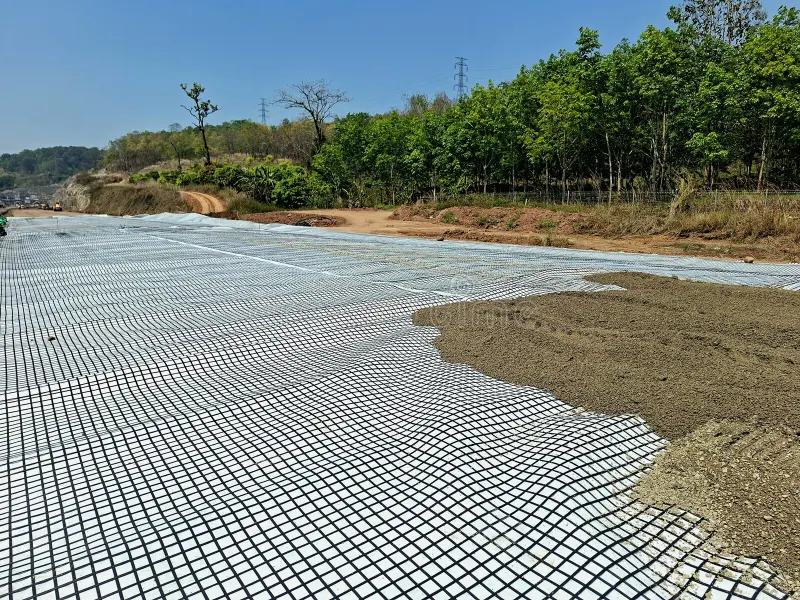
What geogrid does in fill structures
Polymer geogrid interlocks with structural fill to increase bearing capacity and limit deformation under heavy embankments. On dam approach roads, platform edges, and reinforced earth retaining structures adjacent to HDPE geomembrane zones, geogrid is placed in lifts with compacted fill—often over a geotextile separator on soft ground.
Petroseal supplies biaxial PP and uniaxial HDPE grades with published tensile strengths for consultant submittals on Bhasha and Suki Kinari–class projects.
Grade selection
| Type | Typical use |
|---|---|
| Biaxial PP | Platforms, road bases, omnidirectional load |
| Uniaxial HDPE | Steep slopes, walls with primary strength direction |
| 20–60 kN/m | Matched to fill height and surcharge per design |
Installation discipline
- Install taut, flat layers with minimum overlap per drawing
- Protect from UV until covered by next fill lift
- Do not twist or kink ribs during placement
- Coordinate with geotextile when separating soft subgrade from structural fill
Geogrid does not replace geomembrane—it's structural reinforcement. Lined reservoirs still need HDPE geomembrane and geotextile cushion per hydraulic detail.
Supply and references
Nationwide delivery from Petroseal supports WAPDA-scale contractors with geogrid, geotextile, and HDPE geomembrane in one procurement conversation. See our basement and dam lining guides for waterproofing coordination on adjacent structures.
Technical line: 0321 8489737 · petrosealenterprises.com